Why Case-based Reasoning? to automate experiences?
Substantial part of human expertise is experience based, more experience, more problem solving abilities and more expert the person is! Experiences can be treated as cases where a case represents a unique experience. The reasoning based on experiences can be simply called as case-based reasoning, it simply means recalling previous similar experiences and reusing them to get solution to the problem in hand. Although each experience may not be always unique but more similar experiences enhance the confidence of problem solving of similar kind and generalization capabilities.
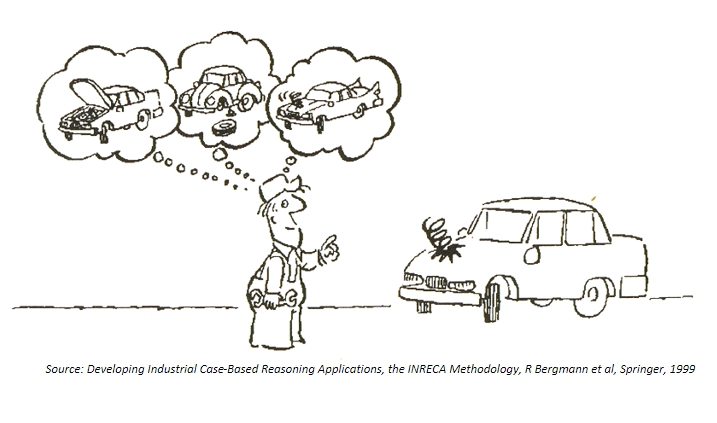
A more practical example, when a patient visits a doctor for medical treatment, the doctor immediately recalls whether he or she had dealt with such similar kinds of problem(s) that the patient is suffering from, in the past. If so, then recalls how were they diagnosed and what kind of remedies and medicines worked well. Once the new patient is treated, that becomes an experience for the doctor. Such experience reuse can be extended to many domains, can a sales person or ecom website remember experiences of selling? and reuse those experiences to sell more and more (to whom, what, when and what price point!); or can automated underwriter recall profiles and behavioural experiences of borrowers who have defaulted in the past and resue those to predict who are likely to default!
Good experiences (for example, customer experiences at sales counter) should be reused however bad experiences should not be repeated (e.g. similar kind of fraud).
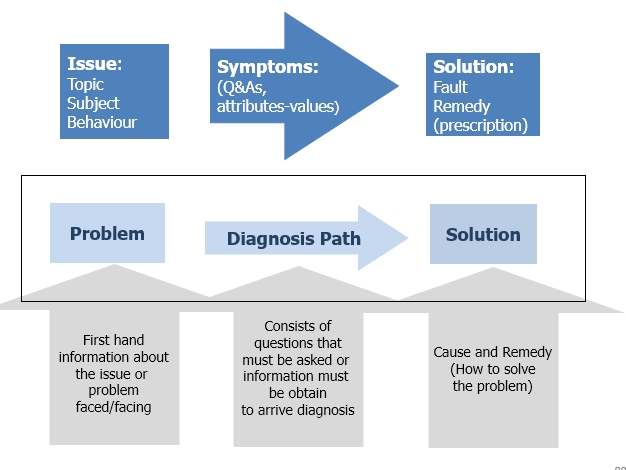
Experiences are presented in case formats have problem description, diagnosis path as well as final solution. It can have qualitative as well as quantitative attributes. Their presentation can differ from domain to domain. A customer buying a product can be an experience, however adding rating or feedback to it completes the experience. In this case the problem specification may be customer demographic profile and solution may be product bought and feedback. Such experiences can be reused for other customers whose demographic profiles are similar in nature to recommend the products.

One of the advantages of CBR, it defers the recalling and reusing experiences as late as possible when a solution to problem is to be obtained, such technologies fall under lazy learners.
CBR system stores the past solved cases, and uses them to solve the new (problem) cases. Since CBR systems deal with the problems by reusing past historical cases rather than complete explicit knowledge of human experts, they can be applied to problem domains where there is a lack of clearly-defined knowledge. The CBR is an approach to incremental and sustained learning because new experience is retained each time a problem has been solved, making it immediately available for future problems. There are a number of problem areas where past experiences are available that can be reused to solve a new problem. To make the past experience reusable, it should contain at least two components: problem specification and its solution. Once the experiences are found where problem specifications are similar, the solutions of similar experiences can be reused to derive a solution to the new problem.
CBR systems use domain knowledge to recall and reuse the cases.

CBR technology has lot of advantages over others: 1> It incorporates domain knowledge, each and every parameter of case can be modelled whether it is numeric or qualitative in nature 2> Models are easier to understand and explain, 3> It can model and deal with qualitative data and no need to convert to some random numbers like required while using quantitative techniques 4> It is lazy learner means takes into consideration the last case added in case-base whenever it finds solution to a problem.
CBR is more suitable when enough cases in structured and reusable form to generalize the problem solving are available.
CBR Recall and intelligent product/content selection and search!
CBR can address large number of business problems. CBR's recall (retrieve) phase has been extensively to select/search various entities in databases. It uses domain knowledge to search most relevant entity(ies) based on the current entity or user specification of entity.